Feature
‘Hybrid’ milks search for right blend
There has been hype around hybrid milks this year as Dutch supermarket chain Albert Heijn backs the concept. But can these drinks hold their own? David Burrows reports.
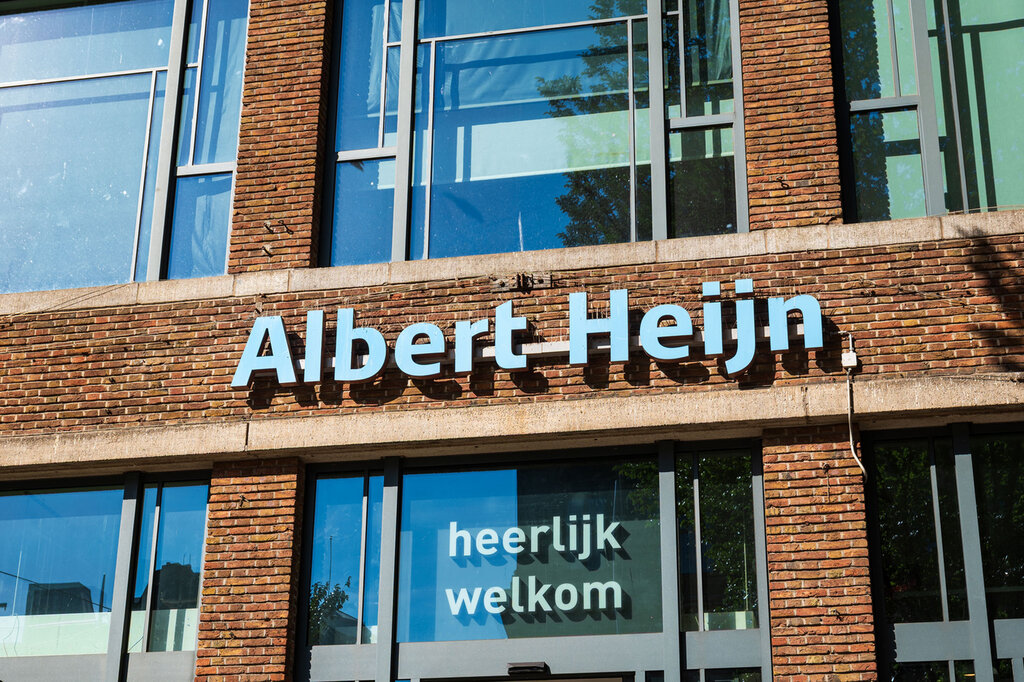
Main image credit: Albert Heijn / PlanetDairy
At Amsterdam’s World of Private Label International Trade Show this summer, Dutch firm Farm Dairy and Denmark’s PlanetDairy introduced a three-strong lineup of ‘hybrid milks’, combining cow’s milk with plant proteins to deliver a reported 20-30% reduction in greenhouse gas emissions.
“Consumers are willing to prioritise sustainable food options but they refuse to compromise on taste, nutrition or price,” said Jakob Skovgaard, co-founder and CEO of PlanetDairy, at the conference, adding: “After the success and learnings from of our blended cheese products in the Nordics, we are now tackling the largest dairy category – milk.”
Skovgaard is a former Arla Foods and Danish Crown executive, who has also worked for Danish beverage group Harboe and Remilk, a food-tech firm based in Israel.
How are things going five months on? The milks are still on the shelf, he tells Just Food, but awareness and rotation still need to grow significantly. “The positioning of both brands and private labels in the hybrid space needs to focus first on the dairy benefits, like taste, functionality and nutrition, [and] secondly [on] less saturated fats, the inclusion of fibres or other plant-based advantages,” he explains. It’s still early days but having major Dutch grocer Albert Heijn brand behind the drinks offers a decent foundation.
Not so Smug now
Going it alone in this new area – pitched between an everyday staple like dairy milk and the ‘sustainable’ alternative of plant-based ‘milks’ like oat, almond and soya – is tough.
In October, after 18 months or so on shelves, Kerry Dairy’s hybrid milks under the Smug Dairy brand in the UK were gradually being pulled. “You’re not imagining it,” a statement on the brand’s website read. “We’ve been slowly stepping out of stores as we say goodbye to the hybrid dairy category. It’s been a wild ride but it’s time for a fresh start, and we’re making way for something new, that is still outrageously tasty, packed with benefits, full-on dairy, yet so unmistakably Smug. We’ll be back in stores next year with a whole new lineup. Think creamy, dreamy, full-on dairy goodness with that signature Smug twist.”

Credit: Just Food
The last few cartons were available in Tesco stores until November. Reviews have by and large been positive. “[T]astes really nice, great in cereal, tea and coffee. Unfortunately, [I] couldn't find it in all stores. Preferred this to my usual Glebe farm oat milk, which is also nice,” said one of the 67% of shoppers who gave Smug’s hybrid milks five stars. “My partner prefers oat milk in coffee, I prefer whole milk. Decided to try this between us and wow! I love this milk so much, it’s so perfect in coffee as it’s creamy and delicious,” said another.
When launching the range – which also included cheese and butter-style products – Kerry Dairy said its aim was “to bring real innovation into the dairy category and shake up binary perceptions of dairy and non-dairy markets”. This was, Kerry’s strategy, marketing and innovation director Victoria Southern said at the time, “a dairy category that is fit for the future”.
Not yet, it seems, at least in the UK. So, will PlanetDairy succeed in The Netherlands and beyond? “It is still very niche,” explains Tom Booijink, senior dairy specialist for Europe and Africa at Rabobank. “I have not seen these products in the supermarket but it doesn’t mean they are not there. I am a statistician though so I am not going to rely on a sample of one.”

They are emerging as a credible growth space because they fit naturally with how people already eat.
Catherine Bayard, Givaudan
The number of launches is still very low, with mixed success. Companies on both sides of the Atlantic have tried and then pulled back. Danone’s Dairy & Plants Blend infant formula (launched in 2022) is still on the market and Bel Group’s Laughing Cow Blends (launched in 2021) are still available on some US retailers’ online shopping sites.
Glass half full
Catherine Bayard, a global product manager at Givaudan, the Swiss multinational manufacturer of flavours, is one of those with their glass half full (of hybrid milk). “They are emerging as a credible growth space because they fit naturally with how people already eat,” she explains. “Taste familiarity is an important factor [and...] the behaviour change is already happening.”
Skovgaard calls hybrids a “low-friction behaviour change”, giving them large-scale potential. “Flexitarians [the brand’s target group] tell us they want less impact but not at the expense of taste or price. Many plant-based milks don’t deliver the full dairy experience and that limits switching. Hybrid milk gives them the taste and functionality of dairy, a meaningful carbon dioxide reduction and no price penalty,” he adds.

Jakob Skovgaard, co-founder and CEO of PlanetDairy. Credit: PlanetDairy
Priced at €1.29 (down from €1.39 at launch, as reported by Just Food),the hybrids are equal to Albert Heijn’s regular private-label dairy milk, cheaper than organic milk dairy and “well below” most oat or almond milks, according to Skovgaard. However, he is mindful of the jump in promotional activity among the branded and private-label pure plant-based milks. “Keeping the product mainstream and affordable was a core requirement from day one,” he says.
The other challenge was technical – hitting that price point with the right taste, colour and nutritional content involved “many rounds” of prototyping with Farm Dairy as well as consumer testing. As Bayard explains: “Dairy still sets the sensory and flavour benchmark and even small amounts of it provide the milky aroma, smooth finish and lipid mouthfeel that reassures consumers.”
It is that familiarity that makes hybrids feel ‘authentic’ rather than experimental. In a large sensory study conducted by Nectar, a research house focused on alternative proteins, nearly three-quarters of omnivorous Americans expressed interest in blended meat products. In the same study, when participants blindly tasted blended burgers, 56% said they preferred them over 100% beef burgers, while only 42% preferred the traditional beef versions.
The findings suggest that when it comes to taste, many consumers are open to, or even favouring hybrid products, suggests Jennifer Behr, director of plant-based initiatives at NGO Mercy for Animals. “If similar dynamics play out in the dairy space, hybrid milks may benefit from that latent openness,” she says.
Balancing act
Research published in August in the journal Food Quality and Preference showed how important it is to get the balance right in these products – and how preferences can differ between consumer groups.
The Brazil-based researchers designed hybrid yoghurts and found the formulations with higher milk content were liked more than those with more of a coconut-based milk alternative. They also noted “stronger associations between health and diet influence perceptions of co-created hybrid products”.
Bayard at Givaudan feels hybrid milks with balanced formulations can stand out if they deliver stronger health credentials than dairy or plant-based options alone. Think elevated nutrition benefits – particularly high protein – gut health and weight management, she says, adding: “There is also a growing opportunity to align with the GLP-1 weight loss trend and support GLP-1-friendly diets.”
Blending allows brands to combine protein with fibre, while reducing fat, which is a strong pull for consumers. Added fibre would be appealing, too (plant ingredients like oats and almonds already carry strong fibre associations), with plant content also aligning with rising gut health expectations – many consumers believe eating a wide variety of plants is important for digestive health.
This makes for a compelling case in support of hybrid milks: the creaminess and mouthfeel associated with dairy, plus the perceived health and ethical benefits of plant ingredients. In fact, oat, almond or grain components can also add smoothness, mild sweetness, natural nutty or grain notes and subtle flavour complexity without straying too far from the ‘true milk’ profile.
Net-zero … now
The carbon footprint also falls the more milk you swap out for plants. The sustainability cues from hybrid milks can be subtle, though. Their lower emissions compared to full dairy – calculated by consultants at CarbonCloud for PlanetDairy – is a “supporting message, not the primary driver”, says Skovgaard, because that is what their consumer research is telling them.
While carbon cuts might not be a big communication push on shelves, behind the scenes there is much to gain from supermarkets hyping up hybrid options – because their net-zero ambitions will require greenhouse gas emissions from livestock products to fall significantly. In time, this will likely involve fermentation-based dairy innovations (and probably cultured meat) but mitigating methane, a short-lived but powerful gas that is emitted by ruminants, is a climate brake that needs to be pulled hard in the short-term, too.
“If we can reduce the problems of dairy and reduce the use of cow-based ingredients by 10% on a large segment of the market (like 90% of the milk category) then our positive impact is a lot higher than if we manage to grow the plant-based sector by 10%,” says Skovgaard.
We can’t wait ten or 15 years for the new technology to happen, either. This is where Skovgaard becomes a little more provocative as he is asked about whether his ‘milks’ are being marketed in a way that will confuse consumers into thinking they are milk as they know it. The designs, as he notes, show the percentages of milk and plant ingredients clearly on the front of packs. “I actually think the Albert Heijn design is quite far from milk,” he says. “As soon as you talk about plants, most consumers will see that as a barrier. If it tastes like milk, and we have a climate crisis … do we need to bother consumers with the choice?”
Sustainability by stealth is an option – a risky one, mind, and perhaps more suited to the foodservice sector. Still, you can imagine that such a move would be very hard for the dairy sector at large to swallow. And imagine the attention on what to call the products. “One thing is clear: these hybrid products cannot be marketed using dairy terms and hence are not part of the dairy portfolio stricto sensu,” says Alexander Anton, secretary general at the European Dairy Association.
The position on such things is set out in Article 78 of Regulation 1308/2013, and the conditions for its use are outlined under Annex VII. The standard position (see Annex VII, Part III(1)) is that the term 'milk' means "exclusively the normal mammary secretion obtained from one or more milkings without either addition thereto or extraction therefrom". However, Annex VII, Part III(3) states: "The term 'milk' and the designations used for milk products may also be used in association with a word or words to designate composite products of which no part takes or is intended to take the place of any milk constituent and of which milk or a milk product is an essential part either in terms of quantity or for characterisation of the product."
So, to simplify, the standard position is that in the EU the term 'milk' can only be used for mammary secretion (so not plant-based milk), without any additions. However, and as Kirsty Poots, an associate at DWF Law points out, there is an ability to use the word 'milk' for a composite product – in law the term ‘composite product’ means a product with multiple constituents, usually products of animal origin/dairy combined with other ingredients. A lasagne, for example, is a composite product.
“In this case,” Poots explains, “there is an argument you could use the word ‘milk’ for a hybrid milk as long as it is made really clear on the packaging that this is used as part of a composite product (that is, it is not just solely 'milk' in its normal interpretation).” The challenge is the wording "no part takes or is intended to take the place of any milk constituent". This is where it all comes down to the marketing as it’s arguable that either: the ‘plant’ based element is intended to "take the place of milk"; or the plant-based element brings its own benefits/characteristics so isn't intended to ‘take the place’ of the milk.
Smug was framed as an ‘addition’ with new and different benefits, rather than “taking the place of”. A spokesperson for Albert Heijn says: “We always follow rules and regulations concerning how we can name our products – in this case [of hybrid milks] by clearly stating that this is a combination product of dairy and plant-based ingredients.” Indeed, it would be hard to advertise to consumers what the product is a hybrid of without using the term ‘milk’ clearly.
Crying over milk split
When asked for their thoughts on hybrids, the likes of Danone, Arla and Oatly all declined to comment. However, one of the larger dairy companies suggests it’s not an area their innovation team has mentioned “so I’m not sensing that it’s an area we expect a lot of”.
Much of the focus for the dairy companies is on rolling out regenerative production to help curb emissions and restore biodiversity. There are doubts about whether this can deliver the deep changes required to successfully meet the twin challenges of the nature and climate crises (especially if companies tweak around the edges rather than overhaul production to follow truly regenerative practices). Reductions in consumption and production will also likely be needed in developed countries regardless.
Care needs to be taken, though. There is a risk that widespread uptake of hybrid milks can “muddy the waters on what good dairy already offers when produced properly. If the goal is health and sustainability, the biggest gains come from how the dairy is farmed and processed, not from blending in plant ingredients,” says Bryce Cunningham, a farmer in Scotland.
Our customer feedback and research has been centred on dairy and its purity.
Bryce Cunningham, Mossgiel Organic Farm
His innovation focus at Mossgiel Organic Farm, which he founded and where he is managing director, is “on making dairy better in its own right [which means] organic, regenerative, high-welfare, minimal ingredient and UPF-free. Our customer feedback and research has been centred on dairy and its purity – especially demand for simple, natural ingredients, no ultra-processing and on good farming standards”, he says, adding: “The consistent message is that people want fewer ingredients, more transparency and dairy they can trust.”
Whether hybrid milks can live up to the hype or prove to be a fad remains to be seen. The value proposition needs to be explicit for shoppers: hybrids must clearly communicate what consumers gain in terms of flavour, nutrition and environmental balance.
The Albert Heijn spokesperson says customers “respond well to products that make more sustainable eating easy without compromising on taste”. In that respect, hybrid milks fit the bill.
They are competing with established companies and products that have established taste profiles. Consumption of dairy milk may well be on the wane slightly but still dominates the category in terms of share. In Europe, plant-based milks have managed to wrestle an impressive 11% share of the milk market, according to Booijink at Rabobank.
Can hybrid milks squeeze share and become a favourite among flexitarians? “We are still early but the signs show that [they] have real mainstream potential,” says Skovgaard.
