
Feature
Seeds of doubt: Big Food faces regenerative‑agriculture questions
Nestlé is using regenerative wheat for KitKats sold in the UK. Is this, David Burrows asks, the big break the movement needs or the latest sign of big corporations ‘fixing’ their ingredient‑sourcing ambitions?

Main image credit:
Is the regenerative agriculture movement among major food and drink corporations a fudge? Something akin to all those 2030 carbon emissions targets made at the start of the decade that are fast approaching and increasingly unlikely to be met; or worse, fading away? Or similar to the promises – made prior to the net-zero ones – to cut back on single-use plastic packaging and now left withering on the vine, labelled ‘too difficult’, ‘too inconvenient’ or ‘too costly’, after five years of failed voluntary action?
These failures do not span all companies, nor are they confined only to greenhouse gases or disposable packaging. However, the collective failures on arguably the two most high-profile environmental sustainability priorities of recent times have led to concerns that the ambition and hype of the regenerative agriculture transition is following the same furrows. At least so far.
“Regenerative agriculture may be reaching a similar stage to net-zero commitments a few years ago,”
María Montosa Ródenas, technical specialist at FAIRR, the investor network, says. Early announcements and broad ambitions have attracted attention, she adds, but investors are demanding more transparency, interim milestones and evidence of real-world impact.
To find that information – if it is even there – you have to dig quite deep; go beyond the farm tours and press releases and into the weeds of corporate reporting. This is exactly what Ródenas and her colleagues have spent recent months doing as they attempted to unpick the regenerative commitments and claims made by 78 of the world’s largest agri-food companies.
The results, presented in June, showed commitments being quietly dropped, contradictory practices and a failure to measure and report outcomes or support farmers.
There was also a big red flag when it came to herbicides and other chemical inputs: FAIRR found 52% of companies identify reducing agrochemical use as a goal, but many of the sector’s most widely adopted practices still depend on herbicides if not implemented alongside other practices. Cover crops, for example, are used by 68% of companies and reduced or no-till farming by 58%, both of which can be heavily reliant on herbicides.
Only Conagra Brands, Danone, Nestlé and Sysco are measuring herbicide use in their regenerative agriculture programmes at all. No company has set a target to reduce pesticide use as part of its regenerative agriculture programme.
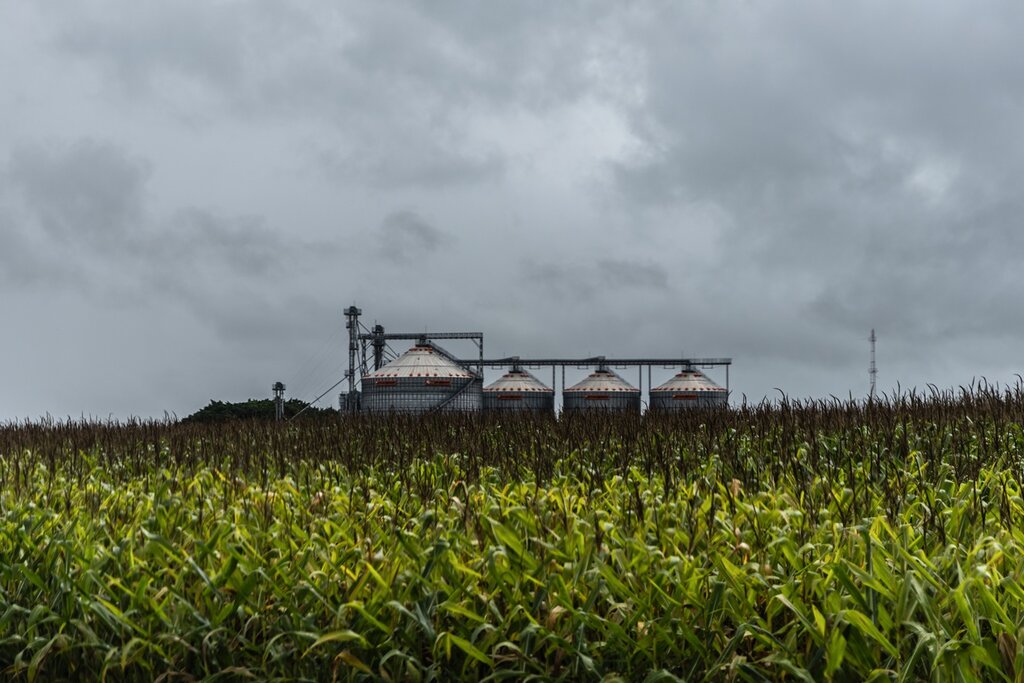
A corn field ready for harvest in front of a silo near Luis Eduardo Magalhaes, Bahia state, Brazil, on 5 March 2026. Photo by Dado Galdieri/Bloomberg via Getty Images
Rose-tinted or truly regenerative?
This is not exactly the picture being painted by companies publicly: one of progressive trials, the potential to reduce emissions and secure supplies; all with photos of smiling farmers as they are helped through what can be a tricky transition to regenerative approaches. “Many agrifood businesses present regenerative agriculture as a silver bullet to meet climate and nature goals,” noted Arthur van Mansvelt, senior engagement specialist at Achmea Investment Management at the launch of the FAIRR report. “But, as investors, we are still struggling to assess the credibility of initiatives.”
To be clear, and as FAIRR has noted, not all of the corporate strategies are as fragmented and under-resourced as the majority. There are bright spots – roses amongst the weeds. There is General Mills’ “clarity” on the scope of its programme and PepsiCo’s outcome-based farmer payment schemes, for example. Carrefour, meanwhile, acknowledges the financial materiality of soil health, biodiversity, water, climate resilience and adequate wages. “[T]here are plenty of examples of companies building credibility and trust on some aspects of their initiatives,” FAIRR says.
However, that cannot plaster over the cracks in these commitments. Indeed, the ‘regen ag’ movement may well have been initiated as greenhouse gas emissions targets loomed into view but the driver now is unquestionably about resilience.
“We're deeply focused on leading a transition to regen-agriculture at scale,” a spokesperson for Nestlé tells Just Food. “Building soil health and resilience is the best possible way for farms and supply chains to increase their ability to cope with the stresses of climate change. By regenerating soils and biodiversity, we also expect farmers will be able to reduce their use of synthetic inputs, further reducing their exposure to unpredictable global fertiliser markets.”
Regenerative agriculture’s big break?
The KitKat and Nespresso owner is among a group of food and drink giants that has been bold in its attempts to bridge the gap between the current system of farming and a new, more resilient one that works in harmony with nature rather than against. The term ‘regenerative’ was mentioned no fewer than 208 times in Nestlé’s 59-page sustainability report in 2021 and almost 100 times in its latest non-financial report for 2025. Between those dates the percentage volumes of key ingredients sourced from farmers “adopting regenerative practices” has gone from single digits to 27.6%. This must be considered good news.
The more significant news arguably came this summer when Nestlé announced its move to use 51% regenerative wheat in the 1.5 billion KitKat bars it makes in the English city of York. The wheat comes from Wildfarmed’s community of UK farmers who “all follow a set of standards based on holistic farming practices aimed at reducing environmental impact and bringing life back to soil”. There have been supporters and sceptics in equal measure. And those that for now are sitting on the fence.
“My first reaction was a smile. My second, almost immediately, was a raised eyebrow,” noted Ian Gould in his sage analysis of the move. Reacting to the announcement, Gill Wilson, an adjunct professor on sustainable marketing at IE Business School in Madrid, said: “We need the likes of Nestlé to be incorporating regenerative ingredients in order for them to mainstream and scale. The question for me is how this will be communicated.”

We need to avoid communicating regenerative to consumers, even when – or if – it is defined more stringently than now.
Ivo Degn, Re:source
Experts have chewed over the brand’s decision not to make mention of regenerative ingredients on its packaging, instead relying on widespread media coverage of the press release. “I really believe we need to avoid communicating regenerative to consumers, even when – or if – it is defined more stringently than now,” explains Ivo Degn, founder of Re:source, a platform for those stewarding regeneration across Europe's agrifood systems. “It will simply be a confusion in the wider sustainability space.”
Such a marketing ploy would more than likely rub against new green claims regulations in markets like Europe. There would be a “big legal risk”, warns Chris Hilson, professor of environmental law at the University of Reading, because the regenerative ingredients are only a small part of the overall product. “They would have to be clear that only [51% of the wheat used is] regenerative – and that would be a marketing own-goal because consumers might be left wondering why the rest was not regeneratively produced.”

Credit: non c / Shutterstock.com
The consumer
Consumer awareness of regenerative agriculture is growing. One of the most recent polls, carried out in the US by non-profit Kiss the Ground and published in June, showed understanding of the farming approach – as ‘holistic farming practices that aim to restore soil health, enhance biodiversity, with benefits for climate and wellness’ – has increased from 7% to 13% in the past 12 months. More widespread adoption will rely not on environmental protection though, but a “me-first mindset”, the researchers noted, with personal health benefits (72%) and food freshness (76%) consistently of far greater importance. “While shopping, 30% of Americans state their top priority is securing more nutrients. This direct link between soil health and human health has gone from niche to an undeniable market force,” they wrote.
Europeans hold similar feelings, it seems. Research published in June by EIT Food, with the help of Dutch retailer Jumbo and Ibiza-based Juntos Farm showed that consumers believe agriculture needs to improve but that ‘resilient’ and ‘regenerative’ are not always engaging consumer-facing terms on their own. “[...] consumers were more likely to value alternative agriculture when it offered tangible personal benefits, particularly health, taste, naturalness, fewer synthetic inputs and credible proof through certification or scientific testing,” the researchers wrote.
Those avoiding the agrochemical element of their regenerative approaches should also note chemical inputs are “the most personally resonant concern”, EIT’s report reads. “The principle of reducing or eliminating synthetic pesticides and fertilisers is the aspect of regenerative agriculture that connects most directly to consumers' own concerns”.
Nestlé’s spokesperson highlights how the Wildfarmed standards reduce fertiliser use with limits on the amounts permitted in any application. Other synthetic inputs are reduced, for example by not permitting use of any insecticide in order to prevent biodiversity degradation. The Wildfarmed website is clear on the fact that “we don’t use fungicides” and “we don’t use insecticides” but the approach to herbicides is more fluid. “[...] we have updated our growing standards for the 2026 harvest to include the use of a targeted herbicide early in the growing season as an alternative to the heavy machinery, soil disturbance and bare earth of mechanical weeding systems.”
Derogations are sometimes necessary but the company declined a request to go into any more detail about the outcomes from such approaches, or the evidence.
Derogations are sometimes necessary but the company declined a request to go into any more detail about the outcomes from such approaches, or the evidence.
Wildfarmed is creating a stir with its regenerative ingredients. Franco Manca, Marks and Spencer, Ask Italian and East Pizzas are among its 1,000 customers. The KitKat tie-up is its biggest break, though, and the heat will be turned up on the outcomes from the farming approaches to where the ingredients end up.
Asked at this summer’s Groundswell Festival about whether he would let any business use Wildfarmed grains, Andy Cato, one of the co-founders, said “yes”, adding: “The first thing written on the office wall at Wildfarmed was ‘The Long Road to Greggs’. Our founding mission was landscape change at scale and the business began with a farming team to deliver financial, community and technical support to farmers. [...] everyone who is using our wheat, oats or barley is directly supporting these farmers in bringing life, resilience and nature back into their fields. That’s the case whether the grain ends up in a sourdough loaf, a scone, a pint or a biscuit.”
Cato is among those who believe the question of what ingredients become must be separate to the question of how things are grown. There are plenty who think differently – and perhaps these sceptics will grow as more FMCGs expand their funding, production and sourcing of regenerative ingredients to be used in less nutritious, or even unhealthy, products. “What is the point in improving the soil’s health to grow a nutritionally dense commodity to then make an unhealthy product?” wondered a reader in a recent issue of Farmers Weekly, one of the most widely read agricultural papers in the UK.
This so-called healthwashing was an issue picked up in a report written by Alice English and Rebecca Tobi in November, with regenerative ingredients used in composite products, from chocolate bars to pizzas, providing a “health halo”. It is perhaps no surprise that PepsiCo, General Mills and Mondelēz International are also among the companies pushing hard not only to increase their use of regenerative ingredients but to tell the world – and their investors – about it.
A lack of common standards
Some are using their own regenerative frameworks and indicators, which creates confusion and the possibility of greenwashing. Others are using third-party certifications and standards like Wildfarmed.
Consumers may not always be getting what they believe they’re paying for.
Sarah Starman, Friends of the Earth
Are consumers being misled? The landscape for regenerative claims and labels is a patchwork of the good, the bad and the ugly, according to a June analysis by Friends of the Earth in the US. “Some regenerative labelling programmes allow the use of synthetic pesticides, including substances linked to cancer, hormone disruption, infertility, and neurological harm,” explained Sarah Starman, a campaigner at the NGO. “Consumers may not always be getting what they believe they’re paying for.”
Starman and her team assessed ten food labelling programmes and found certifications using the term ‘regenerative’ vary dramatically in what they actually require, with some of the most rigorous standards meeting regenerative principles not actually using the term at all. Top performers across the indicators used by FoE – agrochemicals, soil health practices and integrity – were Regenerative Organic Certified, Real Organic Project and USDA Organic. They also assessed three other pillars of regenerative agriculture: whether the label includes criteria related to deforestation and conversion of native ecosystems, animal welfare, and social fairness, including farmworker rights and protections.
Credit: Angela Lock / Shutterstock.com
Banking on regen ag
The tangled topic of farmer finance is one to watch. With the world baking and extreme weather wreaking havoc across a number of major commodities and growing areas, farmer confidence is low; only the brave or well-backed will start transitioning to regenerative approaches.
For McCain Foods, almost 50% of its farmer base is eligible for some form of transition-support programme, including financing, guarantees, incentives and longer-term contracts. "This isn't just a climate change play for us. We really look at this as an assured supply initiative,” Charlie Angelakos, the company’s vice president for sustainability, told Reuters last month.
In its report, FAIRR said financial support to farmers “is growing but there is a gap in transparency”. The researchers say 40% of the 50 companies that mention regen ag “provide some financial support to farmers, transparency about the exact payments given to farmers is low”.
Academics led by Loekie Schreefel from Wageningen University in the Netherlands have analysed the websites of 849 businesses involved in regen ag and interviewed 131 farmers across five European countries. “Our findings suggest regenerative agriculture originated as a grassroots approach to farming that was co-opted by non-farming actors around 2020,” they wrote in their paper for the journal Sustainable Agriculture. “Since 2021, the number of new regenerative farmers declined, raising concerns that the focus shifted from farming to marketing driven by multinational companies.”
The term ‘regenerative’ has been propelled up the green claims charts. Food companies need to reassure farmers and consumers that this is no fudge. Otherwise, it could represent another failure in corporate-led sustainability commitments.
