Cover Story
Safety spotlight returns to infant formula
Infant formula is often described as one of the most regulated parts of the industry – but, once again, the sector is being rocked by concerns over product safety. Liz Newmark reports.
Main photo by Olha Romaniuk/iStock / Getty Images Plus via Getty Images
Following product recalls that started in Europe in December and then spread to more than 60 countries, the infant-formula industry is again under scrutiny – and it insists it is increasing its safety efforts.
“The health of infants and food safety and quality of products remain our sector’s highest priorities,” Beat Späth, the secretary general of Brussels-based trade association Specialised Nutrition Europe (SNE), tells Just Food.
An initial European recall was kicked off in December by Nestlé following the detection of the cereulide toxin in batches of its infant formula. The recall was then expanded globally by the Swiss group in January, when French peers Lactalis and Danone also pulled products, along with some smaller manufacturers.
Späth underlines what the manufacturers have said was the root cause of the recall – a contaminated ingredient. He says arachidonic acid (ARA) from a supplier in China caused the contamination, as cereulide, a heat-resistant toxin produced by bacillus cereus strains, was detected in batches of ARA oil used by infant formula manufacturers.
Six EU countries – Austria, Belgium, Denmark, France, Luxembourg and Spain – and the UK have reported infants with gastrointestinal symptoms after consuming infant formula.
Späth says cereulide is “very uncommon” in ARA oil. “The only effective way to eliminate the risk is to prevent its formation in the first place,” he said.
Nestlé, Lactalis and Danone are among five companies being investigated by the Paris prosecutor’s office into the recalls. All five companies, which also include Vitagermine-owned Babybio and La Marque en Moins, could face fines if allegations are proven.
The investigations have been entrusted to the Central Office for Combating Environmental and Public Health Offenses of the General Directorate of the National Gendarmerie (OCLAESP) and the National Veterinary and Phytosanitary Investigation Brigade of the General Directorate of Food of France’s Ministry of Agriculture and Food Sovereignty (BNEVP).
“The Paris prosecutor’s office decided to take up the case due to the large number of complaints received nationwide and the technical nature of the investigations into regulatory and health issues,” a statement read.
It has also received a complaint from consumer rights group Foodwatch, which is representing eight “individuals” whose children experienced vomiting after consuming infant formula.
According to France’s Ministry of Health, three reports of infant deaths have been brought to the attention of the country’s health authorities in cases where the consumption of infant formula affected by the recalls was reported. To date, the ministry says, no causal link has been scientifically established. Judicial investigations are underway regarding these reports.
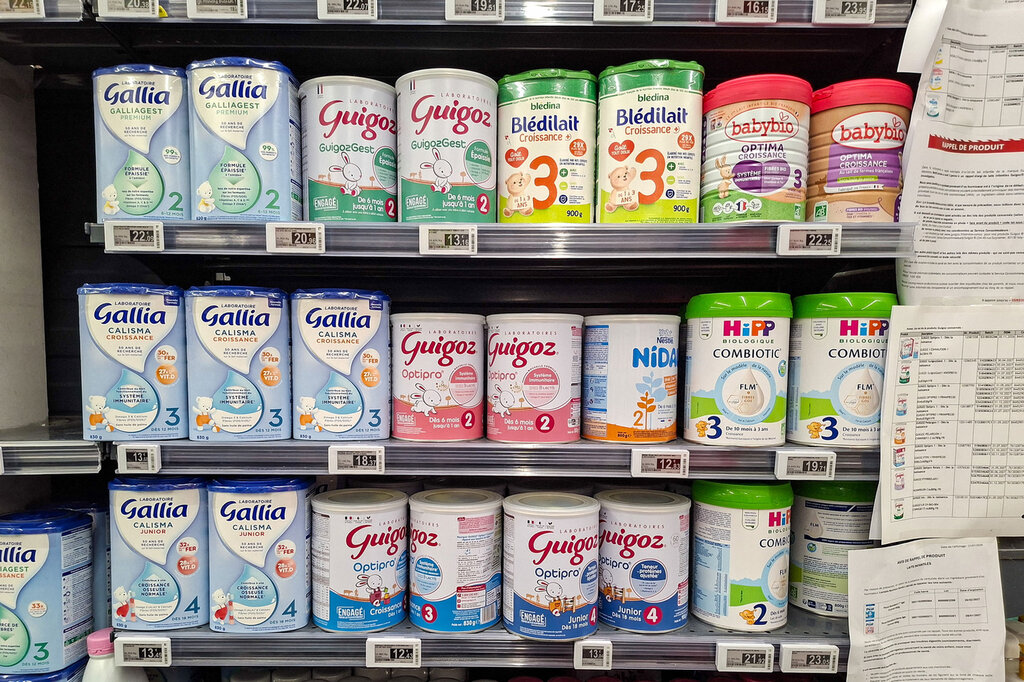
Infant formula brands including Gallia, Guigoz, Bledilait on display in Paris, France, on 10 February 2026 next to a product recall notice for batches of Guigoz products. Guigoz is a Nestlé brand. Photo by Riccardo Milani/Hans Lucas/AFP via Getty Images
Consumer confidence dented – again
The affair has again hit confidence in infant-formula and its supply chains. The industry has been rocked a number of times in the last decade or more, from the melamine scandal in China of the late 2000s to the 2022 product recall in the US that caused nationwide shortages of formula.
In recent months in the US, the country’s Food and Drug Administration has suggested a multi-state outbreak of infant botulism could be linked to a supplier to formula business ByHeart. In November, ByHeart recalled all its infant formula products, including all cans and single-serve “anywhere pack” sticks, nationwide.
As recently as last month, the FDA stressed it continued to receive reports that the recalled formula was being found on shelves, although it said no new cases of botulism had been added to the investigation since 10 December. The regulator declared the outbreak over on 26 February but its probe continues.
The spotlight, then, is firmly on the infant-formula sector once more on both sides of the Atlantic. However, the recall sparked by Nestlé has grabbed mainstream headlines and put the world's largest food manufacturer firmly in the spotlight.
At the end of January, Nestlé acknowledged it had detected “very low levels” of cereulide in formula samples at the end of November – ten days before informing local authorities. The company confirmed it found the toxin in samples at its Dutch factory “at the end of November”.
Nestlé said at the end of November it had sent the contaminated samples for “further, in-depth laboratory analysis”.
The results, which “confirmed the presence of trace amounts of cereulide”, were received by Nestlé “at the beginning of December” and the company “decided to recall all products manufactured since the new equipment installation in our factory in the Netherlands”.
Nestlé said it informed the Dutch authorities and “all potentially impacted countries”, as well as the European Commission, on 10 December to share its analysis.
On the same day, the company said it started a “a voluntary and precautionary public recall” of all 25 batches that had been produced across 16 countries in Europe.

The discovery of cereulide in an oil-based ingredient was unprecedented.
A Nestlé spokesperson
By Christmas Eve, the group said it had confirmation the contamination came from “an oil blend used to produce infant formula in several of our factories”.
Nestlé said it stopped using the blend immediately and told its supplier – which the company has not publicly named – on 29 December once it had laboratory confirmation the oil was contaminated. Trade associations were informed a day later. The wider voluntary recall started on 5 January.
“The discovery of cereulide in an oil-based ingredient was unprecedented,” a Nestlé spokesperson says, as, while the toxin bacillus cereus is known, it is typically associated with rice and cereals, with scientific literature containing no record of cereulide in oils, making it “a blind spot” for the industry.
Nonetheless, the spokesperson says Nestlé’s food safety control systems “detected the toxin, halted production, notified authorities and initiated product recalls”. There are lessons to be learned “about new and unknown risks”, the spokesperson adds, which could emerge from environmental change, new technologies, “or in the case of cereulide, from risks associated with a fermentation process that ended up being imperfectly understood”.
Nestlé says it is using modern technologies and AI to stay alert to new and emerging hazards, while reviewing risks. Auditors are being trained, experts brought in and checklists created for new manufacturing processes such as the extraction of fermented oils, the spokesperson explains.
They add: “Because the company quickly shared its findings with industry and the authorities, Europe now has established regulations for cereulide.”
Credit: Richard Juilliart/Shutterstock.com
Following a “rapid risk assessment” after a request from the European Commission, on 2 February the European Food Safety Authority set a threshold for cereulide at the same level laid down by France a week earlier of 0.014 micrograms per kg of body mass.
EFSA also provided guidance on consumption levels that could risk the exceedance of the newly defined ‘acute reference dose’ based on reconstituted infant formula. It said 0.054 micrograms per litre or infant formula and 0.1 micrograms per litre for follow-on formula “may lead to safe levels being exceeded”.
While the levels are not legally binding, they support risk management decisions across the EU, notably to see when products should be withdrawn from the market, Späth says.
A spokesperson for the European Commission says Brussels has advised national regulators on new action threshold concentrations based on EFSA’s assessment.
“We have been coordinating member states’ work to recall contaminated products since mid-December 2025. Our Rapid Alert System for Food and Feed has played an important role in sharing information swiftly between member states so that they could take the appropriate action,” the spokesperson says, stressing the “responsibility of the food operators, as well as member states, in making sure that safe products are put on the shelves and to swiftly remove potentially contaminated products”.
A Commission official says “a vast array of contaminants can potentially (and unintentionally) enter the food chain”, adding: “For this reason, it is not possible for the Commission to set safety levels for each and every contaminant that exists. By default, the contaminant should not be in the food and this includes the case of the infant formula.”
On 19 February, in a joint statement with the European Centre for Disease Prevention and Control (ECDC), EFSA said they had determined the likelihood of exposure to baby formula contaminated with the cereulide toxin to be “low” given the recalls conducted across the bloc.
A day later, EU member states endorsed emergency controls on imports from China of ARA.
“The contamination was unforeseeable and the distress caused to families and caregivers deeply regrettable. But important changes have been and are being made and infant formula is now safer as a result,” the Nestlé spokesperson says.
“The crisis drove home the need for more robust systems to detect new unknown threats. Nestle’s R&D teams … understand too that unknown risks need more explicit, structured attention and better horizon scanning and AI tools may help in this regard.”
Nestlé, which said last week the impact from the recalls on its first-quarter sales will be around SFr200m (US$258.1m), is mapping all oil ingredients derived from fermentation and other non-traditional methods, reassessing the production and other risks for each ingredient, with priority given to infant-food inputs.
The company is rethinking how it audits suppliers, is sourcing ARA oil from alternative sources – cutting ties with the business at the centre of the recall – and continuing to test all oil ingredient batches for cereulide.
Danone, meanwhile, has increased testing, including adding ingredient controls and checking ARA oil for cereulide. To comply with the latest EFSA guidance, Danone has added to its recalls with the withdrawal of “a very limited number of specific batches of infant formula products”, including Aptamil in Europe and the Middle East.
“We are confident in the safety and quality of our products, which are supported by extensive scientific evidence and rigorous testing. In the light of recent events, we went back to review the level of consumer complaints over the period in question and we didn’t find any cause for concern,” Danone CEO Antoine de Saint-Affrique told analysts last week.
“However, in the context of the ongoing evolution of authorities’ requirements, we are working closely with those national food safety authorities and are taking action to comply with their new requirements. We have been recalling from relevant markets, essentially in Europe and now in the Middle East, batches of infant formula products. While doing this, our focus is on supporting parents and healthcare professionals, providing clear information, and helping to restore trust, as their trust makes all the difference.”
The company estimates the supply disruption will have a one-off impact worth 0.5-1% of its net sales in the first quarter. Taking Danone’s sales of €6.84bn ($8.06bn) in the first quarter of 2025 as a yardstick, that would equate to around €68.4m. Danone’s specialised nutrition division, which houses the infant-formula business, generated €2.31bn in those three months.
Credit: HJBC/Shutterstock.com
At SNE, Späth says some elements of infant-formula manufacturers’ supply chains may appear similar but each operates its own independent sourcing and quality control systems.
Moreover, only a few suppliers, he adds, can provide ingredients “which fulfil the very stringent safety requirements for food for infant and young children”.
Späth insists food safety is the industry’s “non-negotiable top priority” and it supports “continued scientific clarification and regulatory consistency, including greater harmonisation of analytical methods for substances like cereulide”.
He adds: “A clear, science-based and harmonised EU approach will help ensure consistent risk assessment, effective enforcement and continued high levels of consumer protection, particularly for vulnerable groups such as infants.”
The challenge is enforcement consistency and operational discipline, not necessarily a lack of rules.
Dr Sylvain Charlebois, Dalhousie University
Canadian food policy professor Dr Sylvain Charlebois, scientific director of the Agri-Food Analytics Lab at Dalhousie University says infant formula is one of the most tightly regulated food categories, especially in the EU.
“Companies like Nestlé and Danone operate under strict microbiological standards. However, zero risk does not exist. Detection systems are now extremely sensitive and because infant formula has near-zero tolerance for pathogens, even small deviations trigger recalls. Most incidents are linked to process or environmental control issues rather than competitive pressure or innovation,” he says.
To reduce scares, Charlebois says “the priority should be rigorous plant-level monitoring, especially in dry facilities, combined with a strong compliance culture. Transparent and proportionate communication is also essential, as many ‘health scares’ are precautionary recalls functioning as intended. Better communication can prevent unnecessary public panic”.
According to Charlebois, adding more laws is not the answer. “In most advanced markets, the legal framework is already robust. The challenge is enforcement consistency and operational discipline, not necessarily a lack of rules. Strengthening oversight and coordination is likely to be more effective than simply adding more legislation.”
