Comment
New Dietary Guidelines for Americans put industry on notice
The new guidelines could drive significant change across the US packaged food industry, writes Victor Martino.
Main image: An iPhone displaying a social media post from the US Department of Health and Human Services showing the revised Food Pyramid with caption Eat Real Food; Lafayette, California, 7 January 2026. Photo by Smith Collection/Gado / Contributor/Archive Photos via Getty Images
For the first time in history, the US Dietary Guidelines for Americans are calling out highly processed foods and added sugars by name, signalling a shift from past nutrient-focused advice to guidance that evaluates foods themselves.
This is more than a change in tone. It has the potential to reshape how packaged foods companies formulate, market and prioritise their products and could ultimately drive significant change across the industry. Companies that rely heavily on highly processed or sugar-forward products can no longer assume that reformulating around nutrients alone is enough to align with federal guidance.
Historically, the Dietary Guidelines for Americans focused on nutrients like calories, fat, sodium and sugar, not the foods themselves. Products that met these targets were generally acceptable, regardless of processing. That is changing. The 2025–2030 guidelines now urge Americans to reduce highly processed foods, especially packaged and prepared items high in added sugars and refined carbs. (The term “highly processed” is used in the new guidelines because the FDA has not yet finalised a formal definition of ultra-processed foods). By focusing on the structure of foods, not just nutrients, the guidance signals that sugar-heavy, highly processed products are now under federal scrutiny.
Shift from nutrients to foods
For decades, the guidelines focused on individual nutrients. Excess calories and too much fat, saturated fat, sodium and sugar were all highlighted as concerns. Each time, the packaged foods industry adapted. Products were reformulated, front-of-pack claims were added and “low-fat” became “low-sugar”, then “no added sugar” or “reduced sodium”. Processing itself was rarely questioned because it was not the focus of the guidance.
Now that focus has shifted. By addressing highly processed foods, the guidelines ask Americans to look at what they are eating, not just what nutrients it contains. This is a fundamental change. The message to packaged food companies is clear: products that rely heavily on processing and sugar are no longer implicitly acceptable, even if they meet nutrient targets. For many companies, this probably means evaluating entire product portfolios, from ready-to-eat snacks to frozen entrées, to understand which offerings are most exposed under the new guidance.
Added sugar faces a harder line
Sugar has always been a target in the Dietary Guidelines for Americans. Previous editions capped added sugars at 10% of daily calories. The new guidelines go further. Added sugars are now framed as something to minimise, not just limit.

The guidelines are advisory, not regulatory. Yet their influence is wide.
For packaged foods companies, this is a major concern. Sugar delivers taste, texture, bulk, browning and shelf life. It is often inexpensive and deeply integrated into formulation and processing. Reducing sugar can increase ingredient costs, complicate formulations and risk consumer rejection.
Beyond technical challenges, companies must also consider labelling and marketing implications since consumers are increasingly scrutinising sugar content. The guidelines do not offer technical solutions. They simply raise expectations and highlight the pressure on categories where sweetness drives the product’s identity, from cereals to beverages to snack foods.
Guidance carries real influence
The guidelines are advisory, not regulatory. They do not ban products, levy taxes or mandate reformulation.
Yet the influence of the guidelines is wide. They shape federal nutrition programmes, including school meals, the Special Supplemental Nutrition Program for Women, Infants, and Children (WIC) and institutional feeding. They affect procurement standards for government facilities, as well as state and local health initiatives. Retailers often look to the guidelines when setting health frameworks and assortments. Media narratives and consumer perceptions of what constitutes “healthy” food are also shaped by them.
Investors and analysts pay attention too, using the guidelines as a gauge of category risk. Following the 2025–2030 release last month, the share prices of several large food companies came under pressure. While the guidance does not change the rules overnight, it alters the environment in which the food industry operates. Highly processed foods and added sugars are now front and centre. Companies that proactively adapt can gain a competitive advantage, while those that ignore the signals risk falling behind.
Product development in focus
The most immediate implications are for R&D and product innovation. Reformulation has always been a part of packaged foods. Now it is urgent. Reducing sugar and simplifying ingredient lists are no longer just consumer-driven decisions. They are strategic moves to align with federal guidance.
I think packaged food companies will likely accelerate sugar reduction efforts, explore alternative sweeteners, shorten ingredient lists, incorporate more whole or minimally processed ingredients and expand into adjacent categories perceived as less processed. At the same time, companies must decide which products are worth continued investment and which may become increasingly exposed.
Not every product can be reformulated without changing its identity. The guidelines force companies to ask: which parts of our portfolio reflect where the market is going and which reflect where it has been? By calling attention to highly processed foods and sugar, the federal guidance now drives strategy, not just nutrition messaging. Product development teams will need to work more closely with marketing, operations and regulatory departments to ensure new formulations meet consumer expectations and the emerging federal guidance framework.
Marketing under pressure
Implications extend beyond formulation to marketing and messaging. The marketing of packaged food has long relied on nutrient-based claims: fewer calories, reduced sugar, added vitamins.
The new guidance complicates that. Even if nutrient targets are met, products that are highly processed may not be considered healthy.
Brands may reposition products around moderation, occasion or indulgence. Others may focus more heavily on whole or minimally processed offerings. Companies may need to rethink advertising campaigns, front-of-pack messaging and portfolio positioning.
The message is consistent: highly processed foods and added sugars are now under scrutiny and messaging alone cannot overcome that.
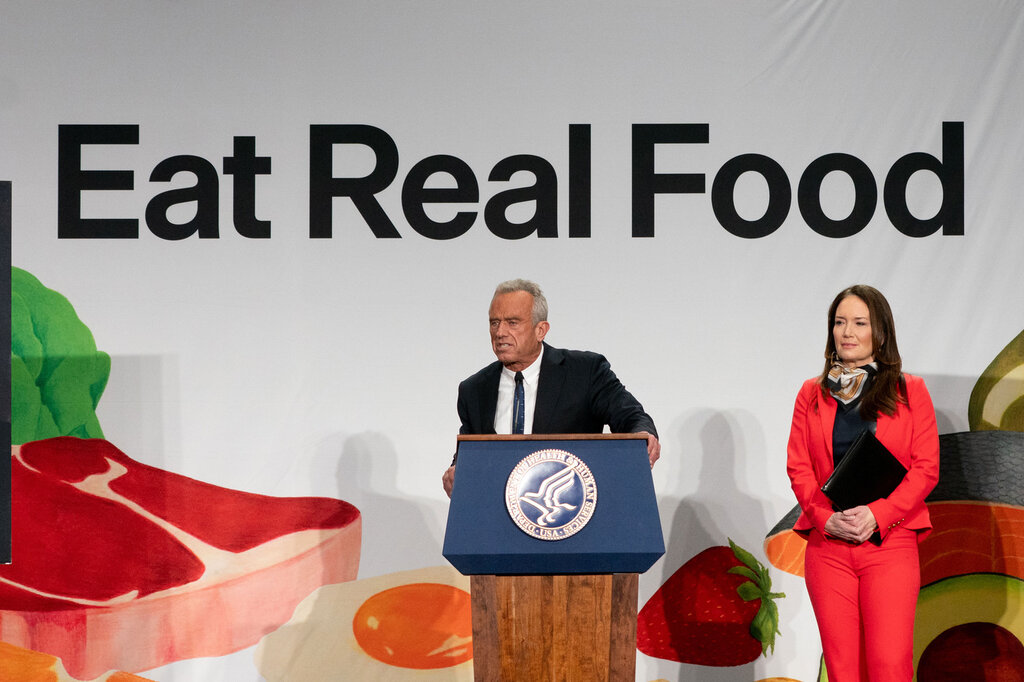
Robert F. Kennedy Jr., US Secretary of Health and Human Services (left) and Brooke Rollins, US Agriculture Secretary, on 11 February 2026 at an to provide an update on the implementation of new dietary guidelines for Americans. Photo by Stefani Reynolds/Bloomberg via Getty Images
Industry change will be gradual
This is not an overnight transformation. Americans continue to rely on packaged foods. Price, convenience and taste still drive purchasing. Consumer habits change slowly and federal guidance does not dictate shopping carts. In other words, packaged foods, including those that are highly processed, aren’t going to disappear off grocery store shelves.
Companies that ignore the guidelines risk falling out of step with regulators, retailers, the media and consumers.
Direction matters, though. For the first time, US dietary guidance aligns with a broader critique of highly processed, sugar-heavy foods. This alignment increases the likelihood that advisory language will shape policy frameworks and market expectations in the years ahead. The thesis remains: highly processed foods and added sugars are now central, not peripheral, to federal guidance.
Companies that ignore the guidelines risk falling out of step with regulators, retailers, the media and consumers. Those that act early may have an opportunity to shape the next chapter of packaged food, rather than defend the last one. Early movers could leverage this shift to introduce innovative products that meet the guidelines while appealing to taste, convenience and affordability, potentially capturing new market segments and consumer loyalty.
Nevertheless, a turning point for packaged foods
The 2025–2030 Dietary Guidelines do not declare war on packaged food. They move the goalposts. By calling out highly processed foods and added sugars explicitly – and at a moment when the US Food and Drug Administration is actively working on a formal definition of ultra-processed foods – the federal government has shifted the burden of proof. Products that once fit comfortably within dietary guidance must now justify their place in a healthy diet structurally as well as nutritionally.
The new guidelines also directly reflect the long-time views and goals of US Secretary of Health and Human Services Robert F. Kennedy Jr. – who’s also the leader of the MAHA (Make America Healthy Again) movement - which include advocating against ultra-processed foods and reforming the food industry in the US. All indications are that Kennedy plans to use the new dietary guidelines as a centrepiece of his food industry reform agenda over the next few years.
For packaged food companies, the question is not whether processing and sugar matter. It is how quickly companies will adapt and whether they will shape the next chapter of packaged food or spend the next decade defending the last one.
