Interview
Rise and shine: Kidfresh tries again at breakfast
Kidfresh, the US children’s food lunch‑and‑dinner brand, is having another crack at breakfast. CEO Michael Allen sits down with Dean Best to talk Kidfresh’s latest morning push and what parents are looking for when they shop for and feed their families.
Main image credit: Kidfresh
U S children’s food firm Kidfresh has built a growing business centred on meals at lunch and dinner time, with a presence north of the border in Canada. It’s now having a second run at breakfast.

Michael Allen, CEO at Kidfresh
Led by CEO Michael Allen, the private-equity-backed company is rolling out products targeted at breakfast time and at the late-afternoon slot before dinner.
“It’s an all-day food platform and, if you look at it from a competitor standpoint, there really aren’t a lot that are doing the same thing,” the former Kellogg executive tells Just Food.
Dean Best: Why try again in breakfast now?
Michael Allen: Our typical demographic is busy households with two children and two incomes. When we asked what we could solve for, our very loyal Kidfresh parents said they wanted what we bring them – better-for-you children’s food, with less mealtime drama – but across a broader spectrum of the day.
The insight was mornings and afternoons or evenings are very different from a parent’s perspective. In the morning, they’re solving for time. In the afternoon – around 4pm – they’re solving for hunger. We thought: can we deliver a breakfast that’s healthier than what’s available and can we do it quickly?
We have a format called the Easy Combo Meal, which we use for a couple of entrées and we put breakfast into that format. We now have scrambled eggs and potato tots and the newest one is pancakes with potato and breakfast sausage.
In addition, on the breakfast side, we have two mini muffin products. They are available in Target and Wegmans stores. This new round of breakfasts is part of a broader focus on snacking opportunities in the afternoon and breakfast. It’s about expanding the portfolio beyond entrées.
Dean Best: You’re launching products specifically for that 4pm slot as well?
Michael Allen: Yes, more for snacking. One we’re launching now is mac-and-cheese bites. We make a very successful mac-and-cheese product and we’re putting it into a bite. Think of it as something a little moreish for 4pm, rather than a packet of crisps. The muffins are suitable for a 4pm heat-and-eat occasion too.
Dean Best: Why did the previous attempt at breakfast not work?
Michael Allen: Only two breakfast SKUs were launched several years ago: waffles. I think the products were very good. Our waffles had real blueberries and real chocolate; the competitive set didn’t. What happened is we launched those products and they went into what I call the sea of waffles.
I used to run the frozen business at Kellogg and the Eggo brand in the United States is worth over a billion dollars. We were a small brand and we put two very good-tasting, nutritionally great products into a wall of everything.
The second thing I’d say is we don’t compete at the bottom end of the market on price on purpose. We choose to be mid- to higher-tier because we need to be, as we spend our money on food quality. We want to provide good value but our parents also want that value to include good nutrition.
Dean Best: What are the key better-for-you claims you’re making across the range? I noticed protein was emphasised. Is there really a protein deficit among children?
Michael Allen: We focus first on what children need. At the younger end of the spectrum, ages two to eight, they need calcium and fibre. When we look at the nutritional propositions on our packs, there are a couple of things we always call out: no artificial dyes or synthetic colours and no artificial ingredients. That’s number one. Number two is we always have hidden vegetables in our product profile.
On protein, I understand what you’re saying because everybody is doing some form of protein but there’s also a discussion about the type and source of protein. Ten years ago, it was only soy. Now, with the availability and cost of pea protein, or protein from vegetables, it’s more balanced.
Yes, we want protein but we don’t start creating products by asking “Do we have enough protein?” We start with vegetables, and second to that, no artificial ingredients. We also get protein from some of our sources. In some products, we have fava beans; in others, we have pea protein. We don’t look for proteins to fit into the food.
Dean Best: Consumers are scrutinising ingredients lists. There’s also an ongoing debate about ultra-processed foods. Where does the Kidfresh brand and product range sit in that debate?
Michael Allen: Two things. There are lots of discussions in the industry about UPC [ultra-processed consumption]. We’ve done the work and know the majority of our products would qualify to carry a non-ultra-processed food logo. We’re a long way down the road on qualifying as non-ultra-processed. We’re choosing not to do that right now because the industry in the United States is still sorting itself out.
The second thing is that, working with our nutrition team, we’re continually looking to upgrade our foods. I’d refer to that as a base food improvement. We always look at two or three things: reducing saturated fat and sodium and adding more vegetables whenever we can. The balance in food, of course, is it has to taste good enough to eat. We walk a fine line but we’re always looking at it.
Dean Best: We’re six years on from the strict lockdowns and hybrid working is a permanent fixture for many parents. For a business like Kidfresh, which offers convenience, are you seeing any pressure on sales because parents might have more time to cook when they work from home?
Michael Allen: Our consumers are two-parent working households. They may be hybrid or not but we know they’re two-income households. The second thing is the pressure is on weekdays, Monday to Friday.
I’d suggest there may be more cooking at home. Restaurant visits in the United States have largely returned to where they were and the move back to the office in North America has gone further than in Europe. I go to Europe quite often and hybrid working in the UK is still more broad and flexible than in the United States. There’s more of a push to go back to the office here.
That being said, I think you make a good point. I do believe there’s more cooking at home and meal preparation but I’d suggest that’s more at weekends. Monday to Friday, it’s about managing time.
Dean Best: Do you think the range might become more weighted towards snacking products over time, rather than meals, because snacking is becoming such a trend across different types of consumers?
Michael Allen: I think it will be weighted in that direction. I’d answer that in two ways. First, I’d suggest our product profile will become more weighted towards different temperature states, with fewer frozen items. Ninety per cent of our product profile is frozen, so being in different temperature states makes sense because it gives you flexibility. That’s the first thought from a grocer’s standpoint when we talk to customers about dayparts and occasions over time.

Our product profile will become more weighted towards different temperature states.
Frank Smith, Founder and CEO of TowHaul
I think the answer also depends on the family. For four- to five-year-olds, snacking is important but the core timings of a proper meal for breakfast and dinner will always be important, too. Your point is well taken, though: how do we provide snacks for four- to six-year-olds that are nutritionally relevant, portable and convenient?
You always get insight if you go and watch soccer practice. We do that all the time and going to a school and seeing what’s coming out of backpacks is very insightful. Depending on the age group, I’m not sure there’s a good range of healthy snacks that are calorically dense and suitable for the energy a child uses up in 60 minutes of playing football. That will always be an opportunity for most brands, I think.
Dean Best: You mentioned earlier that Kidfresh’s pricing is mid- to higher‑tier. What are your thoughts on US consumer confidence at the moment? Are you having to promote more often or become more competitive on price?
Michael Allen: To be clear, I wouldn’t want to give the impression we’re a premium brand because I don’t think we are. I think we’re accessible to everybody. We have a really nice balance of a trade strategy, so consumers can access our brand at a variety of price points depending on the retailer. Retailers determine their promotional strategy for the most part and we try to make our brand accessible at different price points.
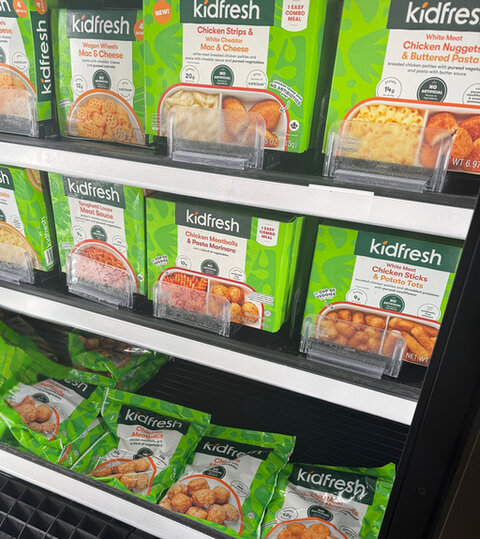
We have a number of customers with a buy-one-get-one strategy, so consumers can access our brand and get two packets for the price of one. We like that strategy because consumption of our food tends to expand: if there are two packets in the freezer, they’ll go just as fast as one.
Overall, we’ll always have a promotional strategy that allows consumers to access our brand. We just tend to be in the mid-tier relative to some other brands and that’s directly related to the cost structure of our ingredients, because they’re the best we can find.
Dean Best: What does your competitive mix look like? Does private label have a significant presence in the category, or is it predominantly brands?
Michael Allen: There are one or two brands and then there’s private label but I’d say private label is more in segments than across a whole brand range. You can buy private-label chicken nuggets and you can buy private-label mac and cheese but there are very few private labels that cover a range of meal solutions; they’re more by SKU or category.
Dean Best: Thinking about your distribution, where do you see sales opportunities at the moment in the US?
Michael Allen: The business was founded in New York, so we’re very well distributed up and down the north-east but also across the country. We don’t really have any gaps now. We have some very large national customers, including Kroger, Target and Whole Foods, so we have strong national distribution but we also have regional pockets, particularly because of the history of the brand. The north-east is our strongest area. The only channel where we don’t compete significantly is club. Other than that, we’re very well distributed in retail and very grateful for it.
Dean Best: You’re on sale in Canada. How have you fared so far?
Michael Allen: It’s interesting. In the United States, we have a range of more than 20 SKUs. We began by saying let’s enter the market because there isn’t a broad competitive set or a brand like ours in Canada. We went in three years ago and we’re building our distribution quite rapidly.
We just got listed in Metro. We’re also in the Pattison Food Group – Save-On-Foods – as well as a number of independent stores. We’re growing our distribution base with our partners as quickly as we can. We only have four SKUs, so we have lots of opportunity.
Most importantly, we do everything for our Canadian business in Canada. We source our materials there and manufacture at a facility just outside Toronto. I’m a little biased because I’m originally from Toronto. Knowing the market fairly well, I felt there was a particular opportunity in Canada and I think being a Canadian-manufactured brand with an established Canadian business is culturally important, as it would be in the UK. Going to the UK one day is a possibility, too.
Dean Best: I suppose that’s been pretty helpful recently given the trade volatility between the two nations.
Michael Allen: I’d say you’re quite insightful with that comment. I think it’s always important in the food business to be culturally relevant in the community you serve. I learned a few lessons in big CPG about trying to take a North American brand into another community. I learned that living in the UK. You’re not going to sell prawn cocktail crisps in North America but we love them in England. That’s just the way it works.
Dean Best: Where does international expansion rank on your priority list? Is it something you may do one day, or are you actively looking?
Michael Allen: If I gave you our priorities from my CEO seat, the first would be to continue looking across dayparts and occasions so we can fulfil the needs of our families. Second would be to always listen to opportunities for partnerships to expand the brand. Third would be to ask where’s next in terms of serving our families across the spectrum of food. That’s the order in which I’d suggest we’re doing things.
Dean Best: What are the company’s annual sales?
Michael Allen: Our sales – I’ll give you a range because, of course, we’re privately held – are in excess of $35m.
Dean Best: Would that be what you’re going to hit in 2026? What’s the target for next year?
Michael Allen: We’re growing. Here’s what I can say: we’ve been growing at a consistent, mid-double-digit rate for over three years. If you look at consumption data, regardless of the source, we’re one of the fastest-growing food brands in the United States right now and we have been for two years.
Dean Best: There’s been some deal activity in ‘better-for-you’ frozen food. What’s the company’s position on M&A? Does it see itself as an acquirer, perhaps rolling up adjacent products or businesses, or are you positioning yourselves as a bolt-on target for a legacy food company?
Michael Allen: I think either way. We have two primary investors in our business and they’ve been in for quite a while – since the founders originally started the business. We have very close partnerships with them and always have. I think we look at it both ways. I’m always open to listening to any conversation, either strategic or non-strategic. What I do think is there are very few large CPG brands of scale doing the kinds of things we’re doing right now. We may appeal to some.
I’m always open to listening to any conversation, either strategic or non‑strategic.
Frank Smith, Founder and CEO of TowHaul
That said, there are a lot of challenges for large-scale CPG businesses right now in doing unit-volume. A lot of companies are trying to reach their performance and targets – especially if they’re public – through dollar sales growth, often through list-price increases or by managing trade and reducing their footprint on cost of goods.
Our business is kind of unique over the last several years in that we’re growing unit volume. The rate I referred to is not dollar sales growth; it’s unit growth. We’re at a very unique stage for a food company, growing at this scale across unit volume. We have more consumers buying our brand more often and more items when they do buy, at a price point. That’s quite rare in my experience.
